


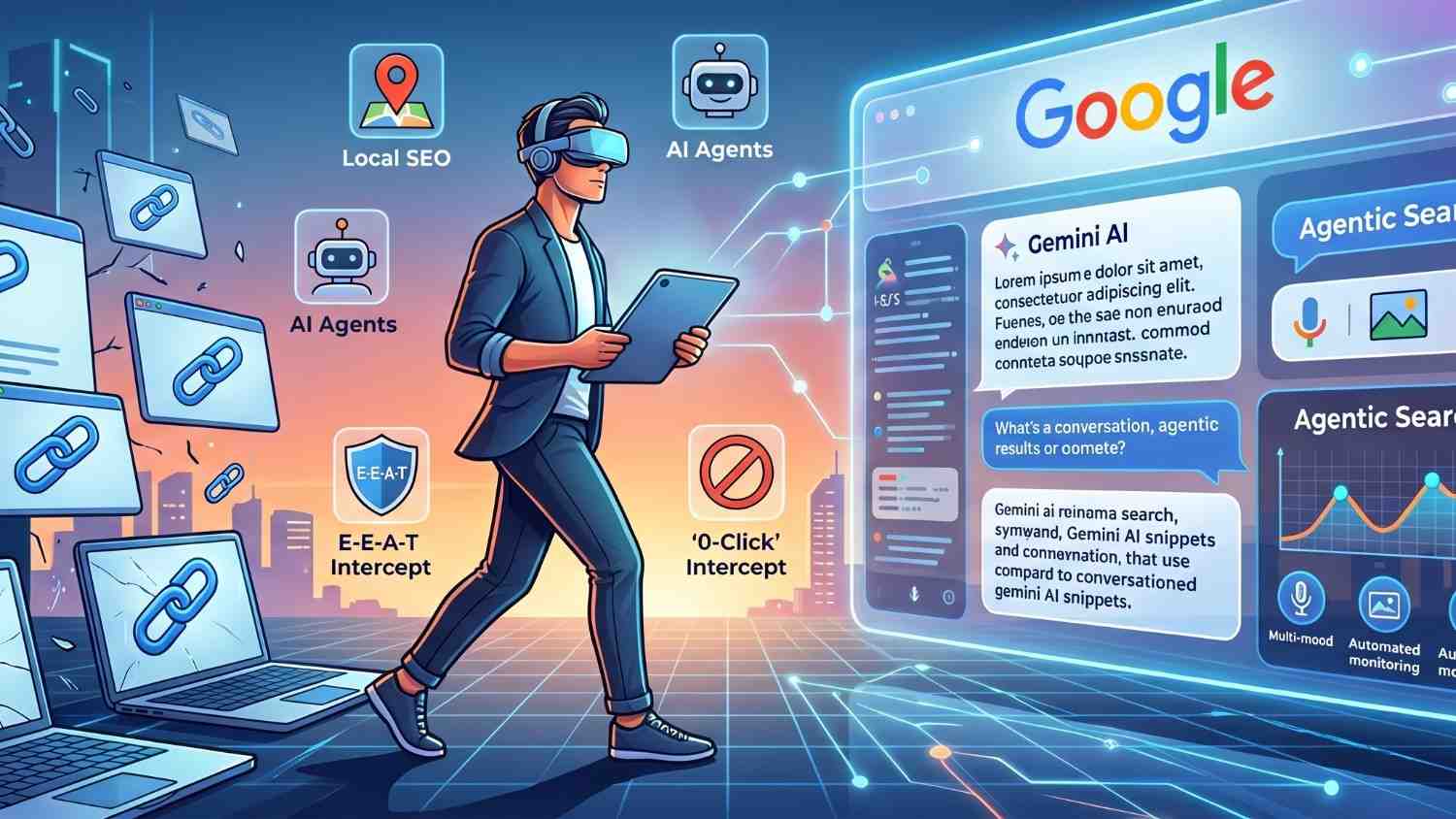
If you have been monitoring your website traffic over the last week, you might have noticed some serious turbulence. Your frustration is completely valid, but you are not imagining things.
On May 21, 2026, Google officially began rolling out its highly anticipated May Broad Core Update. Launching concurrently with the massive AI announcements from Google I/O, this update fundamentally alters how search engines evaluate content, measure authority, and present answers.
The era of optimizing solely for ten blue links is fading. Google is heavily prioritizing its AI-first ecosystem, and if your SEO strategy has not evolved, your visibility is likely at risk.
If you want to understand why your rankings are shifting and how to adapt your strategy to recover and thrive, you are in the right place.
Let us dive into the specific changes Google made this May, how they affect businesses, and how you can adapt your playbook.
First and foremost, the most visible change accompanying this core update is Google’s new Search interface. Powered globally by the new Gemini 3.5 Flash model, Google has effectively merged its AI features into a single, unified flow.
Users can now transition seamlessly from a standard search engine results page straight into an endless, conversational AI dialogue without ever clicking a traditional link.
The search box now expands dynamically and accepts multi-modal inputs like images, files, videos, and even Chrome tabs.
Google also introduced AI Information Agents that run in the background around the clock to monitor the web for users.
Because of this, purely informational, top-of-funnel content is losing clicks fast. If your website relies on answering basic questions, the AI will intercept that traffic. To survive, your SEO must pivot toward deep, experience-based content that an AI cannot easily replicate.
Furthermore, the May 2026 update takes an aggressive stance against low-effort content ecosystems.
If you used generative AI to spin up hundreds of blog posts on broad topics without adding real human value, this update is targeting you.
Google is specifically cracking down on:
Mass-produced, repetitive AI text with poor readability and no original media.
Buying old domains to piggyback on their authority with unrelated content.
Manipulating backlinks to boost low-quality affiliate pages.
Instead of rewarding high-volume content, Google is aggressively prioritizing topical authority.
Publishing fewer, highly researched, and deeply insightful articles within a specific niche will perform far better than trying to rank for every high-volume keyword in your industry.
Another crucial shift we are seeing in the SEO community involves Local Search. If you run a local directory or a massive aggregator site, you might be seeing a massive drop in visibility for “near me” terms.
While these changes are global, let us look at what this means for a localized market like Florida. Florida’s economy is heavily driven by tourism, real estate, and local services. All of these industries are directly in the crosshairs of these new AI agents.
For instance, if you own a boutique hotel in Key West or an HVAC company in Orlando, the way customers find you is shifting rapidly. In the past, a tourist might search for the best hotels and click on a listicle from a massive travel blog. Now, a traveler might use a Google Agent to monitor boutique hotels in Key West for a family of four under $300 a night for next weekend.
Google’s AI will bypass the middleman directory sites and look directly for the source. This means it will pull data directly from your website, your booking availability, and your verified Google Business Profile.
Therefore, Florida business owners need to ensure their technical SEO is flawless. Accurate pricing, live inventory feeds, and clear service areas are more important than ever.
On a more technical note, it is vital not to panic over every metric you see right now. Coinciding with the May update rollout, many SEO professionals reported that the Google Search Console (GSC) links report started behaving erratically.
Specifically, webmasters are seeing their backlink counts drop drastically, with some even reporting zero links.
Before you panic, know that this appears to be a reporting glitch tied to the update’s rollout and not necessarily a penalty.
Therefore, your baseline for performance should be the weeks prior to May 21st. Wait at least one full week after the update finishes rolling out before making any drastic technical changes.
What does this mean in the broader digital marketing world? Sites that exist simply to aggregate information are losing ground.
If an AI can accurately summarize an answer or track a product’s price, users simply will not click through to a third-party blog.
Beyond marketing, these agentic systems are absorbing entry-level repetitive tasks. Information agents will soon replace manual data monitoring in finance, real estate, and market research.
Digital marketers must pivot from traditional keyword stuffing to feeding AI agents the precise, structured data they need to make decisions.
In light of these massive shifts, you need a proactive strategy to protect your rankings. Here is a clear list of things to be doing today:
If you sell a product or service, ensure your website explicitly states what you do, where you do it, and your availability. Do not rely on third-party directories to list you.
Since AI handles top-level research, focus your SEO efforts on specific use cases, buyer due diligence, comparison pages, and specific scenarios (like what to expect during a hurricane roof inspection in Miami).
Your content must demonstrate true Experience, Expertise, Authoritativeness, and Trustworthiness. AI cannot test a physical product or share a unique industry anecdote, but you can.
Google announced Search agents that monitor the web for users, alongside a new Universal Cart that handles checkout directly via Google Pay across Gemini and YouTube. Being the actual merchant or brand owner is the most durable play.
Over-optimizing your content with unnatural phrasing just to get cited in Google’s AI Overviews is a dangerous game. Focus on semantic understanding, clean site architecture, and solving the user’s intent.
Core updates take weeks to roll out. Wait for the dust to settle before deleting pages or entirely rewriting your site based on early data in Google Search Console.
Navigating Google’s new AI landscape can be overwhelming, but you do not have to do it alone.
If you are worried about how this May 2026 core update will impact your traffic, it is time to partner with the experts.
Reach out to the Expresso Company today. Our team specializes in future-proofing your digital presence, ensuring your technical SEO is flawless, and adapting your content so customers can always find you no matter how Google changes its search engine.
Let us build a strategy that turns these algorithm updates into your biggest competitive advantage.
In conclusion, the Google May 2026 Core Update is a clear warning shot for those relying on outdated SEO tactics.
The transition from keyword-matching to an AI-driven, conversational search ecosystem is no longer something happening in the future. It is happening right now.
Ultimately, the businesses that will win in this new era are those that stop chasing algorithms and start building genuine brand authority, publishing uniquely valuable content, and providing an incredible user experience.
It is a major algorithm update that started rolling out on May 21, 2026. It focuses on rewarding high-quality, authoritative content while cracking down on scaled AI spam, thin affiliate sites, and unhelpful information aggregators.
Announced at Google I/O, these AI agents work in the background of your search app. Users can give them a prompt (like finding a specific apartment or monitoring a price drop), and the agent will scan the web continuously, sending a personalized alert when it finds an exact match.
Not necessarily. In fact, local service providers might actually benefit. AI agents prefer pulling data directly from the actual business rather than a middleman directory. If your website and Google Business Profile are accurate and optimized, AI can connect customers directly to you.
Google core updates typically take about two weeks to fully roll out. You should wait at least a full week after the rollout is officially complete before analyzing your baseline traffic and making any major structural changes to your site

