



The digital marketing landscape is currently navigating a seismic shift that many industry experts are calling the second coming of the internet. For decades, SEO professionals and business owners have focused almost exclusively on the Google search results page, perfecting the art of ranking for blue links.
However, with the meteoric rise of generative AI, a new player has entered the arena. Understanding how users interact with AI models is no longer an optional skill for the elite, it is a competitive necessity for every brand.
In April 2026, we are finally seeing the long-term impact of these tools. To understand the reality of this change, we are looking at a landmark study from Semrush, which analyzed over 1 billion lines of U.S. clickstream data over a 17-month period (October 2024 to February 2026).
This data provides the context we have been missing, moving us away from “guessing” and toward a data-backed strategy for ChatGPT traffic analysis.
For the first time in twenty years, the traditional search funnel is fundamentally changing. Instead of typing a few keywords into a search bar and browsing a list of links, users are having long, nuanced conversations with AI.
According to recent data from First Page Sage, the platform has surpassed 180 million monthly active users, many of whom treat ChatGPT as a primary research assistant rather than a simple chatbot.
The challenge for most marketers is that ChatGPT has historically been a “black box.” Unlike Google Analytics, which tells you exactly which keywords brought a user to your site, AI referrals are often more mysterious.
However, the Semrush clickstream study reveals that outbound referral traffic from ChatGPT grew by a staggering 206% throughout 2025. This means that while users are spending more time inside the chat, the AI is increasingly acting as a high-intent doorway to the open internet.
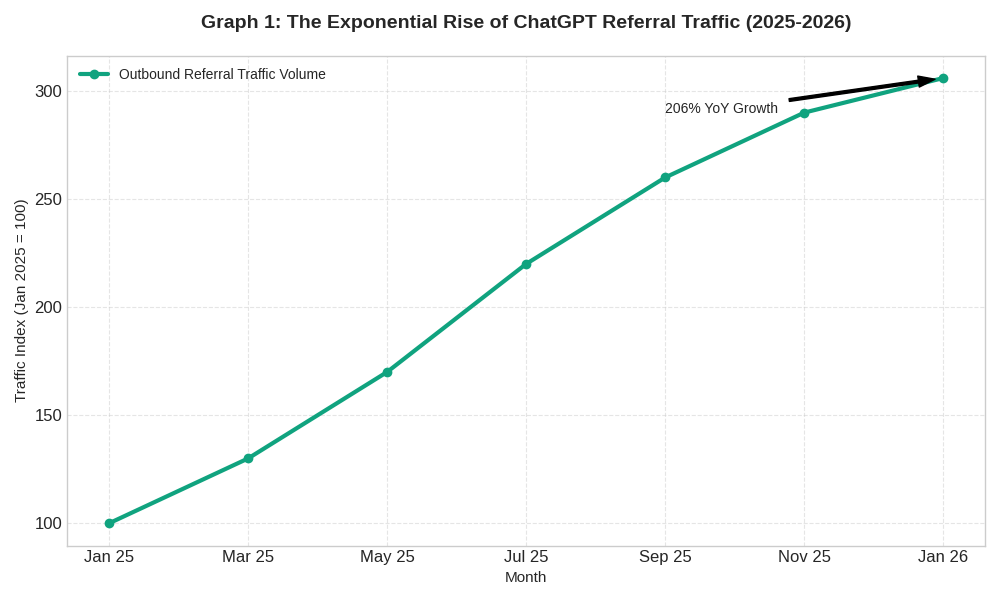
As seen in the data above, even though total user growth began to plateau around late 2025, the “propensity to click” through to an external site continues to rise.
This marks the transition from AI as a knowledge silo to AI as an agentic search engine, a tool that actively bridges the gap between a user’s complex problem and a brand’s solution.
To master generative AI search metrics, you must first understand how traffic actually flows from a Large Language Model (LLM) to your website. Generally, this happens through citations, source cards, and clickable links provided in the chat interface. However, the logic behind these links is not as straightforward as a Google algorithm.
A critical insight from recent clickstream data shows that ChatGPT does not search the live web for every single query. In fact, it enabled its web search feature on only 34.5% of queries in early 2026.
This is a significant decrease from the nearly 46% we saw in late 2024. This change suggests that the model is becoming more confident in its internal knowledge, which makes your historical presence even more important than your real-time updates for the majority of queries.
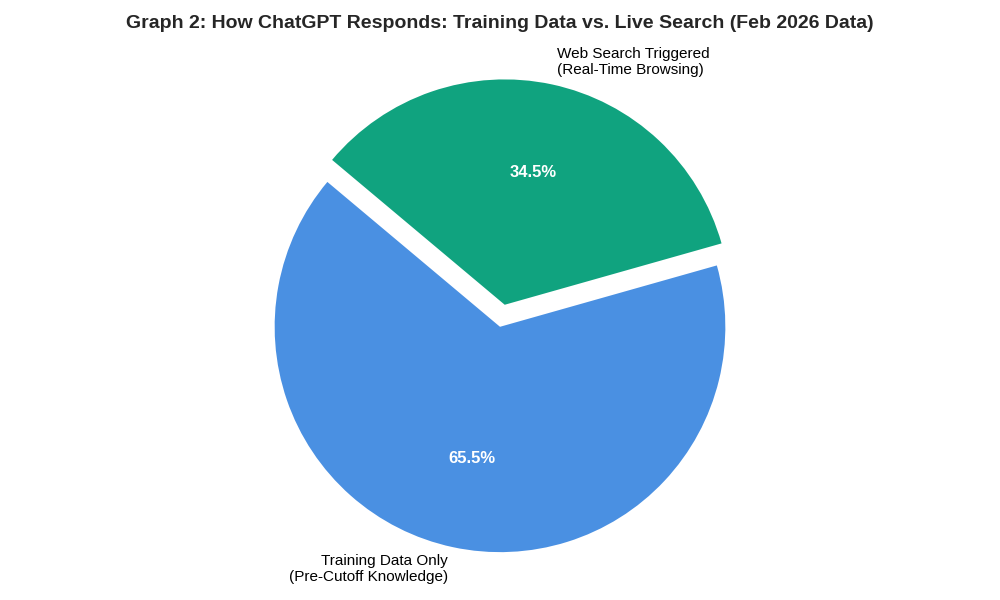
The remaining 65.5% of responses rely entirely on the model’s internal training data. As of early 2026, the knowledge cutoff for ChatGPT is June 2024. This context is vital for your SEO strategy:
This means your AI-driven traffic evaluation must account for two different strategies: one for long-term brand authority (to get into future training sets) and one for real-time technical SEO (to win the 34.5% of live searches).
One of the most powerful techniques in modern SEO is reverse-engineering the prompts that users are likely using to find your content.
While OpenAI does not yet provide a “Search Console” for prompts, you can use existing data to make highly educated guesses and perform competitor AI benchmarking.
Start by looking at your Google Search Console data for long-tail keywords. Queries that start with “How do I,” “What is the best way to,” or “Explain the difference between” are prime candidates for AI prompts. If you are ranking for these on Google, it is highly likely that users are asking ChatGPT these exact same questions to get a more personalized answer.
To develop this further, you must look for keywords with high impressions but low click-through rates (CTR) on Google. This often indicates that the user is looking for an answer directly in the results, which is a “zero-click” search. These users are rapidly shifting to ChatGPT for those same answers.
By identifying these informational clusters, you can determine which pages on your site are being used as the “ground truth” for AI responses. You should then refine these pages to be even more “citation-friendly” for the AI by using clearer, more authoritative language that an LLM can easily summarize.
Go to ChatGPT and ask it about your industry specifically. For example, if you sell high-end software, ask: “What are the most reliable CRM systems for mid-sized law firms in 2026?”
If your brand is not mentioned, analyze the brands that are. Look at the specific language the AI uses to describe them.
By exploring these gaps, you can see exactly what “knowledge tokens” the AI is looking for. If the AI is missing key information about your brand, it is a sign that your content is not scannable or authoritative enough for its current model.
This form of competitive intelligence allows you to update your site to include those missing data points. By doing this, you ensure that the next time the AI crawls or references your niche, your brand is the obvious choice for a citation. You are essentially feeding the AI the specific data points it prefers to use when recommending products.
Advanced tools like Morningscore or AISO allow you to see the types of questions that have high search volume. Instead of looking for single words, use these tools to filter for “question-based” keywords. This helps you build a list of prompts that you want your website to be the source of truth for.
Furthermore, analyzing these patterns helps you see if users are looking for comparisons, step-by-step guides, or “best of” lists. When you see a high-volume question pattern that your site does not adequately answer, you have found a prime opportunity for new content.
These prompt-first content strategies ensure you are capturing the traffic that starts in a chat window rather than a search bar. You are building a library of answers designed to be picked up by the AI as the definitive resolution to a user’s problem.
Once you have analyzed the traffic, the next step is optimization. This is often called Generative Engine Optimization (GEO). This goes beyond traditional SEO because it focuses on how an LLM synthesizes and summarizes your information rather than just how a bot indexes it.
AI models love structured data because it removes ambiguity. By using Schema.org markup, you make it easier for ChatGPT’s crawlers to understand the context of your page immediately.
Whether it is a product review, a technical guide, or a news article, clear metadata ensures that when a user asks a relevant prompt, the AI can pull your data accurately.
For 2026, you should focus on more advanced schemas like “Speakable,” “About,” and “Mentions.” These tell the AI exactly what entities your page is an expert on. If your page is about AI-driven traffic evaluation, ensure the schema explicitly identifies that as the primary topic.
This structural clarity is the difference between being a background source and being the primary citation the AI gives to a user. It gives the model the confidence to link to you as a definitive authority because your data is organized in a way that the AI can parse with zero errors.
Experience, Expertise, Authoritativeness, and Trustworthiness (E-E-A-T) are more important than ever because AI models are trained to avoid “hallucinations.” ChatGPT often cites sources that appear the most authoritative in its training set.
To increase your AI referral rate, focus on building high-quality backlinks from reputable news sites and producing original research that others reference.
AI models are trained to recognize patterns of authority. If your brand is cited frequently across the web in “Big 10” domains like Wikipedia, Reddit, or major publishing sites, the AI is significantly more likely to recommend you as a trusted answer.
In GEO, your reputation is your ranking factor. You must prove to the AI that your information is the most reliable “ground truth” available on the internet. This requires a shift from quantity to quality in your backlink strategy, as the AI cares less about the number of links and more about the “clout” of the domains linking to you.
Stop writing for bots and start writing for conversations. Because ChatGPT interacts via natural language, your content should mirror that logic. Using a conversational tone with clear headings makes it easier for an LLM to parse your information and present it to the user.
Avoid keyword stuffing and instead focus on entity optimization. This means using synonyms and related concepts naturally. For example, instead of repeating ChatGPT traffic analysis ten times, discuss AI-driven traffic evaluation, LLM referral auditing, and generative AI search metrics.
This variety helps the AI understand the breadth of your knowledge, making your content more resilient to different types of user prompts. It demonstrates that you understand the entire topic, not just a single keyword, which increases the likelihood that the AI will use your site to answer a wider range of user prompts.
While Generative Engine Optimization (GEO) ensures that your brand is the “source of truth” cited in a chat window, visibility is only the first half of the modern search equation.
In the 2026 landscape, we are moving beyond users simply reading about solutions; we are entering the era of AI Agents. AI Agents are autonomous versions of LLMs that don’t just summarize information, they execute tasks. They navigate websites, fill out forms, and make decisions on behalf of the user.
If GEO is the strategy that gets you invited to the conversation, Agentic Search Optimization (ASO) is the strategy that ensures the AI Agent chooses your brand to complete the job. To thrive in this ecosystem, you must move beyond standard SEO and embrace the technical requirements of these autonomous “buyers.”
The Semrush clickstream study highlights a critical shift: users are spending 50% more time in multi-query sessions.
This indicates they aren’t just looking for a fact; they are working through a process. ASO is designed to make your website the path of least resistance for an AI Agent during that process.
Since prompts are becoming longer and more complex, your content should be structured to answer follow-up questions. Users in 2026 are not just asking “What is SEO,” they are asking “How do I implement SEO for a 12-person remote marketing team using specific tools.”
Your content must be deep enough to act as a thinking partner. Don’t just explain what a product is, explain how it integrates into a specific workflow. This makes your site a better candidate for those high-engagement, multi-query sessions.
If your page provides a comprehensive solution that spans multiple steps, the AI will stay on your source longer, increasing the likelihood of a direct click-through to your site for the implementation phase. You want to provide the “next step” before the user even has to ask for it.
While informational prompts are conversational, navigational and transactional prompts still look like traditional keywords. When a user is ready to buy or log in, they become very direct. Ensure your product names and login pages are clearly defined in your metadata.
If a user says “Take me to Expresso Company’s login,” and your site is buried under technical debt, the AI might send them to a third-party directory instead.
Use clear, branded titles and ensure your “About” and “Contact” pages are easily accessible. This clarity ensures that when a user moves from research mode to action mode, the AI knows exactly where to send them without friction. You want to be the destination the AI points to when the conversation turns into a transaction.
Since 30% of traffic goes to the top 10 domains, getting mentioned on “Big 10” sites like Wikipedia, major news outlets, or Reddit is more important than ever. ChatGPT views these domains as trusted hubs of human information.
Think of these platforms as bridges. A mention on a high-authority site is often what leads the AI to discover and then cite your smaller, niche site. If a Reddit thread discusses your expertise and links to your blog, the AI perceives that as a vote of confidence from a human-centric platform.
In ASO, your visibility on these major hubs is just as important as your own website’s SEO. You are creating a web of citations that all point back to your central domain, making your authority impossible for the AI to ignore.
You cannot improve what you cannot measure. In the traditional SEO world, we focused on rankings and keyword positions. However, the AI interaction era requires a more nuanced set of KPIs.
To truly understand if your strategy is working, you must focus on how deep your brand penetrates the conversational journey. Here is a detailed breakdown of the three primary metrics you need to track to gauge your success in the AI era:
This metric measures the total number of sessions originating from AI domains such as chatgpt.com, openai.com, or perplexity.ai, serving as the most direct indicator of your AI visibility.
Furthermore, the Semrush clickstream analysis highlights that outbound referral traffic from ChatGPT grew by a staggering 206% throughout 2025. By monitoring this volume in your GA4 Traffic Acquisition reports, you can determine if your content is successfully triggering the AI to provide clickable citations.
Ultimately, a rising AI referral volume suggests that you are successfully capturing the informational searches that are being redirected from traditional search engines.
This metric evaluates how closely your top-performing pages match the actual narrative prompts users type into ChatGPT.
Because recent findings revealed that between 65% and 85% of prompts do not match traditional keywords, simple keyword matching is no longer sufficient. Consequently, success is measured by your site appearing as the source of truth for complex, multi-step queries.
For instance, if a user prompts for a comparison of CRM software for remote teams with 12 people and the AI cites your page, your Prompt Alignment is high.
This demonstrates that you are successfully answering the how and why that AI models prioritize rather than just the what. In addition, high alignment ensures you stay relevant in the 34.5% of queries where the AI triggers a live web search to find the most accurate answer.
This metric tracks how users interact with your site once they arrive from an AI chat, focusing on whether they stay longer or visit more pages. Unlike a standard Google searcher who might click on the first link they see, an AI-referred user is a pre-vetted lead.
Moreover, insights from the AISO Traffic Analysis Guide suggest that these users are further down the intent funnel because the AI has already summarized your content for them.
Therefore, a high Engagement Rate, which is often characterized by lower bounce rates and higher session durations, indicates that your landing page successfully provides the deep-dive information the AI promised.
If your engagement is low, it instead suggests a disconnect between the AI’s summary and your actual content.
The world of ChatGPT traffic analysis is still in its infancy, but the early adopters will be the ones who define the rules of the game. By understanding usage statistics, reverse-engineering prompts, and optimizing your content for the way AI thinks, you can ensure that your brand remains visible in the age of generative search.
Start auditing your referral traffic today and turn the “black box” of AI into your most powerful marketing asset.
Navigating the complex landscape of clickstream data, prompt optimization, and agentic search is a massive undertaking. You should not have to do it alone.
Expresso Company specializes in helping businesses bridge the gap between traditional SEO and the new era of AI search. We help you decode the prompts that matter, optimize your site for AI crawlers, and ensure that when a user asks ChatGPT for a solution, your brand is the answer.
To see this traffic, navigate to your “Reports” section, then “Acquisition,” and finally “Traffic Acquisition.” Look for the “Session source/medium” dimension. You should look for entries like chatgpt.com / referral or openai.com / referral. To make this easier to track, you can create a custom segment that filters specifically for these sources. This allows you to analyze the behavior of AI-referred users separately from your organic search or social media audience. You can then see which specific pages are acting as the best landing zones for AI users and optimize them further for conversions.
Yes, and in many cases, it is more valuable than standard organic search traffic. When a user clicks a link within ChatGPT, they have usually already been “pre-sold” or informed by the AI’s summary. They are looking for the source material to complete a task, verify a fact, or make a purchase. Because the user is further down the “intent funnel,” the conversion rate from AI referrals tends to be higher. However, this only works if your landing page directly addresses the specific prompt they were just discussing with the AI. You must ensure the landing page provides the deep-dive details the AI could only summarize.
You cannot force it in the traditional sense, but you can significantly increase the probability through Generative Engine Optimization (GEO). This involves using clear, declarative sentences, implementing high-quality Schema markup, and ensuring your site is easily crawlable. Additionally, being featured in reputable directories and having high-authority mentions on sites like Wikipedia or major news outlets increases the likelihood that the LLM’s knowledge base identifies you as a top-tier source. The goal is to make it easy for the AI to choose you as the correct answer by providing the most comprehensive and well-structured data in your niche.
Keyword research focuses on short phrases or terms users type into a search box, for example, “best running shoes.” Prompt research, however, focuses on the intent and the natural language structure of a conversation, such as, “I am a beginner runner with flat feet, what shoes should I buy for a marathon?” ChatGPT traffic analysis requires shifting your mindset from targeting words to targeting solutions and multi-step instructions. You are looking for the “why” and the “how” behind the search, which allows you to create content that serves as a complete answer rather than just a keyword match.
It is unlikely to replace it entirely, but it will certainly cannibalize informational search traffic. For quick facts, definitions, or summaries, users will stick with AI because it is faster and more direct. However, for shopping, local services, and deep-dive research, traditional search and direct website visits will remain relevant. The goal of your AI-driven traffic evaluation should be to capture the informational intent via AI citations while maintaining your transactional intent through traditional SEO. You want to be present at every stage of the journey, whether the user is chatting with an AI or searching on Google.

